

Policy & Regulation
Tokenization
Stablecoins
Building with Regulators, Not Against Them: Key Takeaways from DC Blockchain Summit
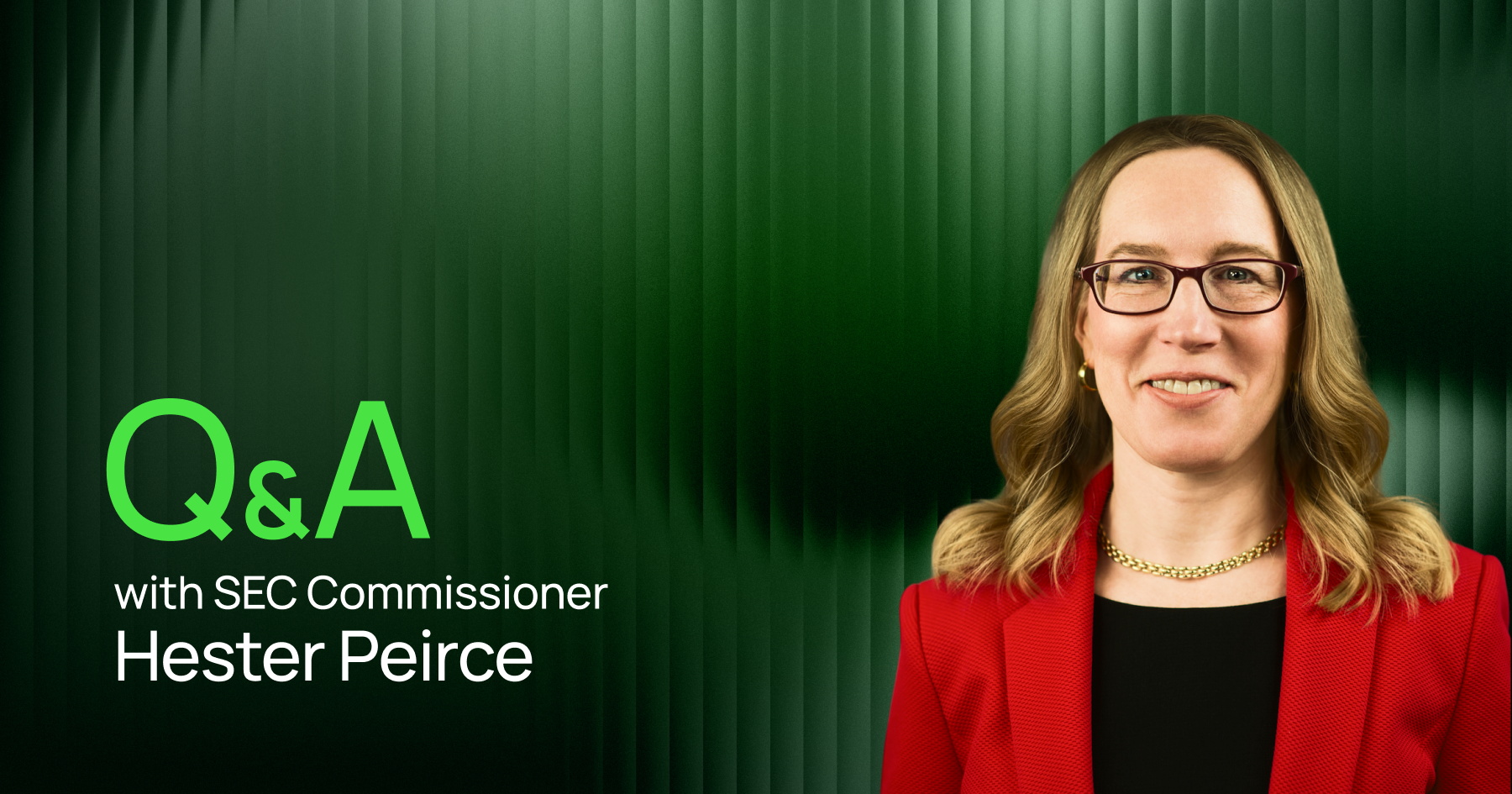
On March 18, 2026, at the DC Blockchain Summit, zerohash Chief Legal Officer Stephen Gardner sat down with SEC Commissioner Hester Peirce for a candid fireside chat on the future of crypto regulation, tokenization, and onchain markets.
The conversation comes at a pivotal moment. Following a wave of regulatory shifts in 2025, including the formation of the SEC's Crypto Task Force and new guidance around token taxonomy, the industry is entering a new phase, one defined less by uncertainty and more by collaboration between builders and regulators.
Below are the most compelling moments from the discussion.
On the SEC's shift toward clarity
Stephen Gardner: Starting with the creation of the task force … How did you go about prioritizing such a monumental task?
Hester Peirce: “It's really nice to be with you today… It is good to be at the Commission at a time when the Chairman is really interested in moving along toward clarity. And I think when acting chairman … came in and put me in charge of the task force. His mandate really was … let's really focus our resources on trying to get the clarity … our first task was just listening to people… trying to get written input, have round tables and hear from people what they thought was important… one of those issues that kept coming up… was, ‘Tell us, when is something a security when is it not?’”
On what’s coming next: tokenization and innovation exemptions
Stephen Gardner: What are the next tangible items that may come out of these efforts?
Hester Peirce: “This idea of enabling people to do capital raising using a crypto asset. Tokenization of traditional securities has been a topic that has really [gotten] a lot of interest from crypto native firms, but also from traditional firms. We want to see what tokenization could do for our traditional stock and bonds … Another thing to be on the lookout for is an innovation exemption. We want to give people the comfort to be able to tokenize traditional securities and to interact with them.”
On balancing innovation and investor protection
Stephen Gardner: How do you weigh investor protection with those safe harbors that may come along, or innovation exemptions?
Hester Peirce: “Well, investor protection is always going to be a dominant concern. Part of investor protection is making sure that people have access to products and services that could make their lives better. You can' just say, ‘Only incumbents can do what incumbents are doing now.’ We will be willing to make adjustments. We're also open to the idea that there are times when the technology can take the place of a regulatory requirement. We're not trying to say, ‘You tokenize something, you get to just avoid all the rules.’”
On DeFi and the role of intermediaries
Stephen Gardner: Who is the arbiter of what is DeFi? Where does the intermediary kind of dissolve?
Hester Peirce: “I mean, it does depend on the context. You as a project can define what you want it to look like. If you want it to be fully decentralized, tell us what that is … I think we've had this very much black and white, but I think what I care a lot about is the ability of people who want to interact directly with the protocol. They don't want to bring an intermediary into that. We just all have to be vigilant to make sure that we're not forcing an artificial intermediation.”
On 24/7 markets and operational realities
Stephen Gardner: How does the SEC think about a 24/7 market once these “plumbing” questions get answered?
Hester Peirce: “There's already a move from the traditional side into crypto folks saying, ‘Why isn't everything 24 hours a day?’ … It’s just a natural evolution of the market. Liquidity spreads out across the trading day … There are operational issues. How do mutual funds price themselves if there's no end of day? These are kind of the operational questions that we're considering.”
On regulatory coordination and the role of Congress
Stephen Gardner: Can the SEC and CFTC together get the industry comfortable with the expectation that the federal branch will pass a bill?
Hester Peirce: “We're all excited to see Congress get clarity over the finish line because it can provide that kind of durability. Bringing in the CFTC is such an important point. You have two regulatory agencies saying, ‘No, it's mine.’I think the ability to come together and give people clarity will help to build that framework. But ultimately, it's always good to have the blessing of Congress.”
On building through regulatory uncertainty
Stephen Gardner: How do we future proof this progress in the event of changes in Congress?
Hester Peirce: “If you build things that solve actual problems in society, and people are using those things, it will be very hard for the government to come and take them away… build useful things… identify problems where the technology can be helpful and build those things… and I think we will then be able to keep it regardless of the administration.”
***
The conversation underscored a clear shift: crypto is no longer operating at the edge of the financial system. It is increasingly being shaped alongside it. Regulators are listening more. Builders are engaging more directly. And both sides are converging on a shared goal: making digital asset infrastructure usable, compliant, and scalable.
For zerohash, this is exactly where we operate—between innovation and regulation, helping financial institutions bring digital assets, stablecoins, and tokenized products to market in a way that works within real-world constraints.
As Commissioner Peirce put it, this is not just a moment for government. It's a moment for everyone building the future of financial markets.