
Wealth
How a Global Bank Brought Trusted Crypto Trading to Millions of Clients
A large global bank with strong franchises in wealth management and self-directed trading was seeing clear signals from its clients: spot cryptocurrency trading had become one of the most requested capabilities on the platform. The bank’s self-directed investing unit, which serves millions of retail and institutional clients across web, mobile, and active trading platforms, wanted to find a partner that would allow them to meet that demand without compromising the bank-grade risk and compliance standards its clients count on.
What the bank was looking for
Rather than build a fully licensed crypto stack internally, the bank wanted a path that let the team move quickly while meeting institutional standards for control, compliance, and client experience. Speed to market was a top priority.
“Time to market was critical. Standing up a cryptocurrency business internally would have taken a very long time. Technically, it was something entirely new for our organization, and building it would have required significant effort," the bank executive shared.
Regulatory readiness mattered just as much. "Regulatory hurdles were another major factor. Obtaining the licenses to operate a crypto business internally, including money transmitter licenses, would take years. We believed regulatory clarity would eventually simplify entry, so rather than go through that lengthy process ourselves, we chose to leverage a partner’s existing regulatory infrastructure licenses to accelerate market entry," the interviewee explained.
The bank also wanted to keep full control of the client relationship. “Controlling the client experience was non-negotiable for us. We needed to make sure that trades flowed through our digital ecosystem; our website, mobile platforms, and trading platforms," the interviewee said. And clients expected nothing less: "Clients expect us to choose a partner that safeguards their assets and delivers a seamless experience through our platforms. They don’t want to be redirected elsewhere; they just want it to be easy."
Why zerohash
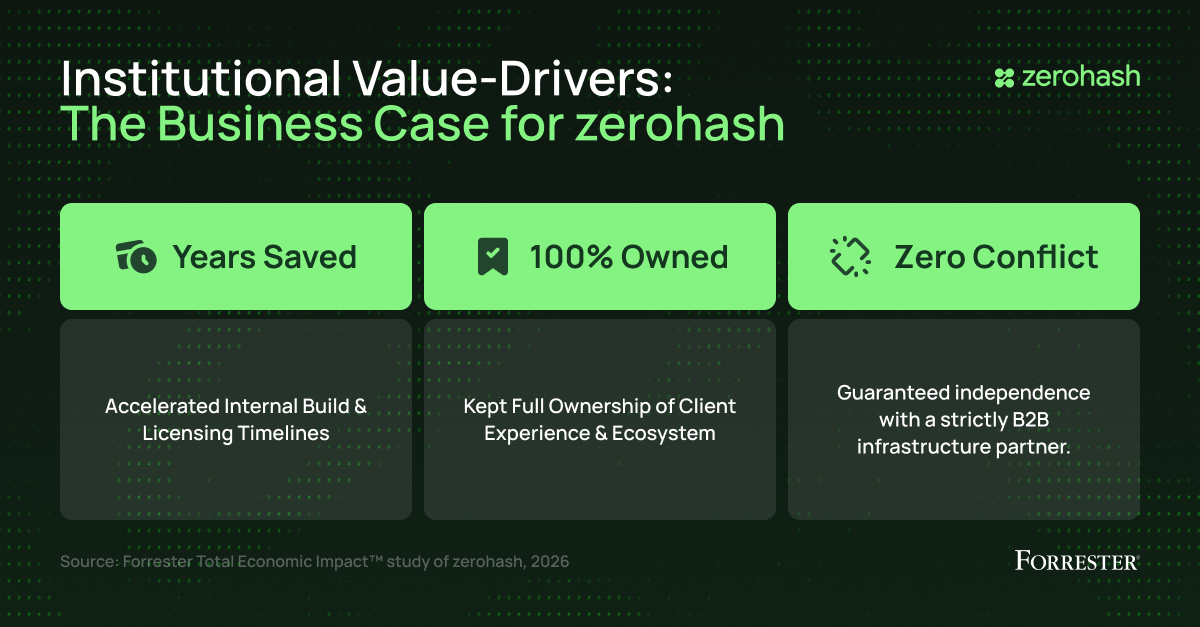
After a multi-month RFP against several finalists, the bank chose zerohash, citing regulatory coverage, institutional experience, and a model built for banks rather than adapted for them.
“Some providers didn't have the licenses required to support us, which was a major compliance concern. For a global bank, regulatory coverage isn’t optional. We needed a partner with money transmitter licenses and other approvals in place across multiple jurisdictions,” the interviewee said.
Experience working with regulated institutions stood out, too. “We needed a provider that had done it before, that was critical for us. We wanted a partner that understood how to work with a firm like ours and already had controls in place from previous partnerships. Most crypto companies don't typically work with traditional financial institutions, so that capability mattered,” the interviewee explained.
zerohash's neutral, B2B-only posture removed another common source of friction. “Some providers competed directly with us: not just in crypto, but also in traditional equities and options markets. That was a major concern. zerohash stood out because it doesn’t operate a B2C platform, so there was no conflict of interest."
And the process itself reinforced the decision: "We went through a very extensive RFP process with the final four crypto provider contenders across small groups. As we went through that process with all partners, zerohash scored higher on every area that we checked."
"We trust that zerohash has the expertise and proven experience to succeed with a firm like ours. We're a trusted custodian of client assets... What matters is that clients come to us because they trust we can keep their assets safe. Serving our clients is at the core of what we do.”
What’s ahead
With the foundation in place, the bank is already looking past its initial launch. The plan is to expand the available tokens based on client demand, and to build toward staking, lending, stablecoin payments, and tokenization as those capabilities mature.
“zerohash is helping us not only deliver what we need in the immediate term but also think strategically about the future,” the interviewee said. “As we plan for phases two, three, and beyond, we work closely with them to identify what's next for our clients; whether tha’'s more tokens, staking, payments, or lending.”
The bank also sees an opportunity to reach a segment of investors that existing products haven’t fully served. “The younger generation clearly wants access to cryptocurrency in the spot market. zerohash is helping us find ways to serve younger investors, continue growing, and retain those clients over time.”
This post draws on an interview conducted for a Total Economic Impact™ study by Forrester Consulting, commissioned by zerohash, March 2026. This interview spotlight reflects a qualitative perspective and was not part of the study's quantified financial model. The study is not meant to be used as a competitive analysis. Forrester makes no assumptions as to the potential value that other organizations will receive; readers should use their own estimates within the framework provided in the study to determine the appropriateness of an investment in zerohash.